



ZEPARI Insights: Five Strategic Takeaways from the Technical Validation Workshop
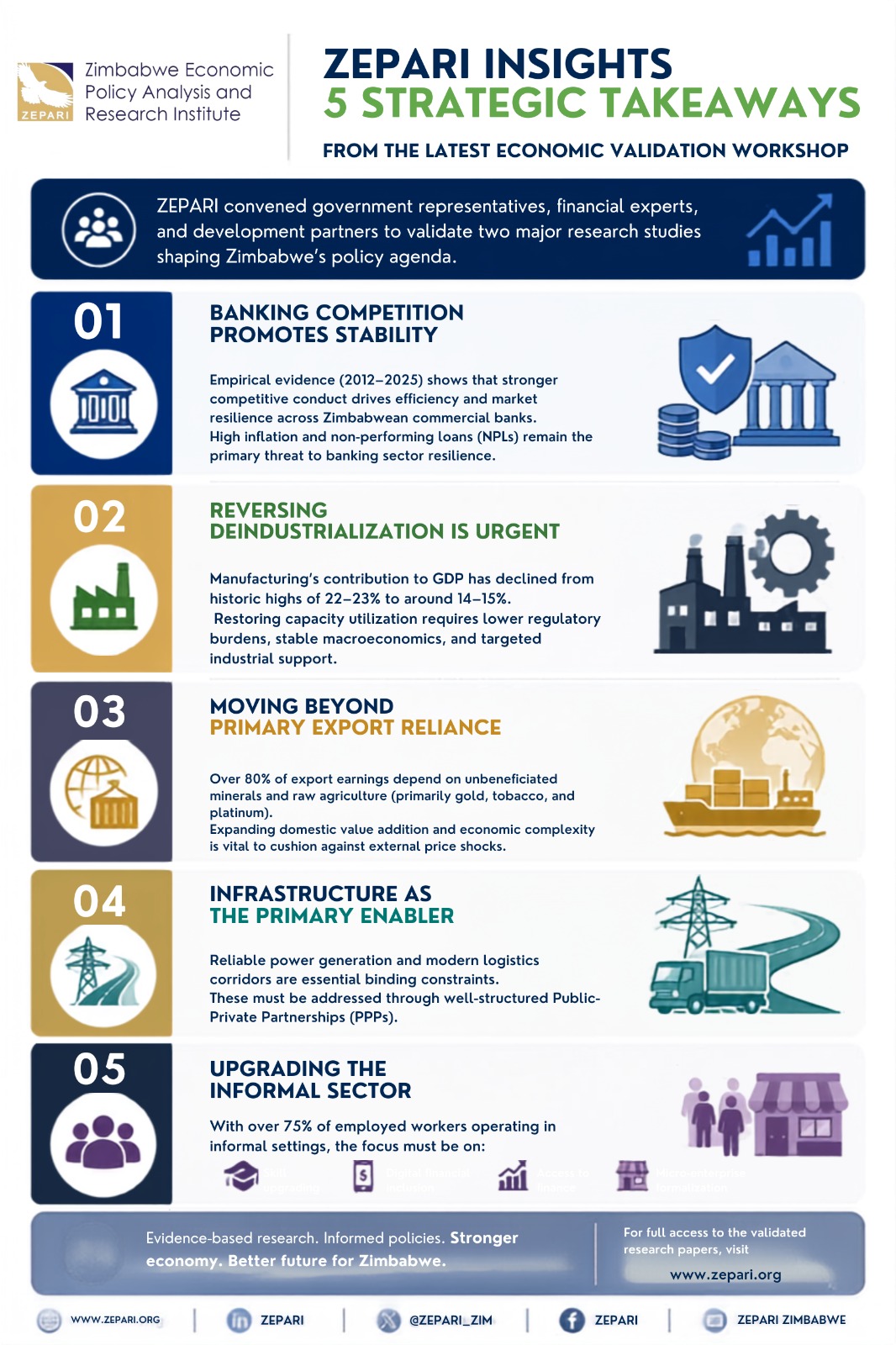
The Zimbabwe Economic Policy Analysis and Research Institute (ZEPARI) recently convened government representatives, financial sector experts, development partners, and academia to validate two major research studies aimed at informing Zimbabwe's economic policy agenda.
Here are five key insights emerging from the studies:
- Greater Banking Competition Strengthens Financial Stability
The research found that healthy competition among commercial banks promotes greater efficiency and strengthens financial stability. However, persistent inflation and rising non-performing loans (NPLs) continue to pose significant risks to the resilience of the banking sector.
- Reversing Deindustrialization is Critical
Zimbabwe's manufacturing sector has declined from contributing approximately 22–23% of GDP at its peak to around 14–15% today. Revitalizing industry will require macroeconomic stability, an improved business environment, and targeted support for productive sectors.
- Zimbabwe Must Move Beyond Primary Commodity Exports
More than 80% of Zimbabwe's export earnings continue to come from largely unprocessed minerals and agricultural commodities, particularly gold, tobacco, and platinum. Increasing value addition, beneficiation, and economic diversification will help reduce vulnerability to global commodity price fluctuations.
- Infrastructure Remains the Foundation for Economic Transformation
Reliable electricity, efficient transport networks, and modern logistics systems remain essential for improving industrial productivity and competitiveness. The studies highlight well-structured Public-Private Partnerships (PPPs) as a key mechanism for accelerating strategic infrastructure investment.
- Formalizing the Informal Economy is Essential for Inclusive Growth
With the majority of Zimbabwe's workforce employed in the informal economy, policies that promote skills development, digital financial inclusion, access to finance, and enterprise formalization will be critical to expanding productivity and creating sustainable employment.
As ZEPARI continues to promote evidence-based policymaking, the validated findings from these studies will contribute to strengthening Zimbabwe's economic reforms under the National Development Strategy 2 (NDS2) and the country's Vision 2030 agenda.
By Decent Moyo