




Zimbabwe's Economic Reset: Gains, Risks and the Road to 2027
ZEPARI Economic Insights | Pre-Budget Analysis
A decade of economic restructuring has delivered a larger economy, steadier prices and stronger external balances. As Treasury prepares the 2027 National Budget, the central question is how to turn these macroeconomic gains into jobs, higher incomes and resilience to shocks.
At a glance
- Growth: Treasury reports the economy is more than twice its 2017 size, with real growth of 8.3% in 2025.
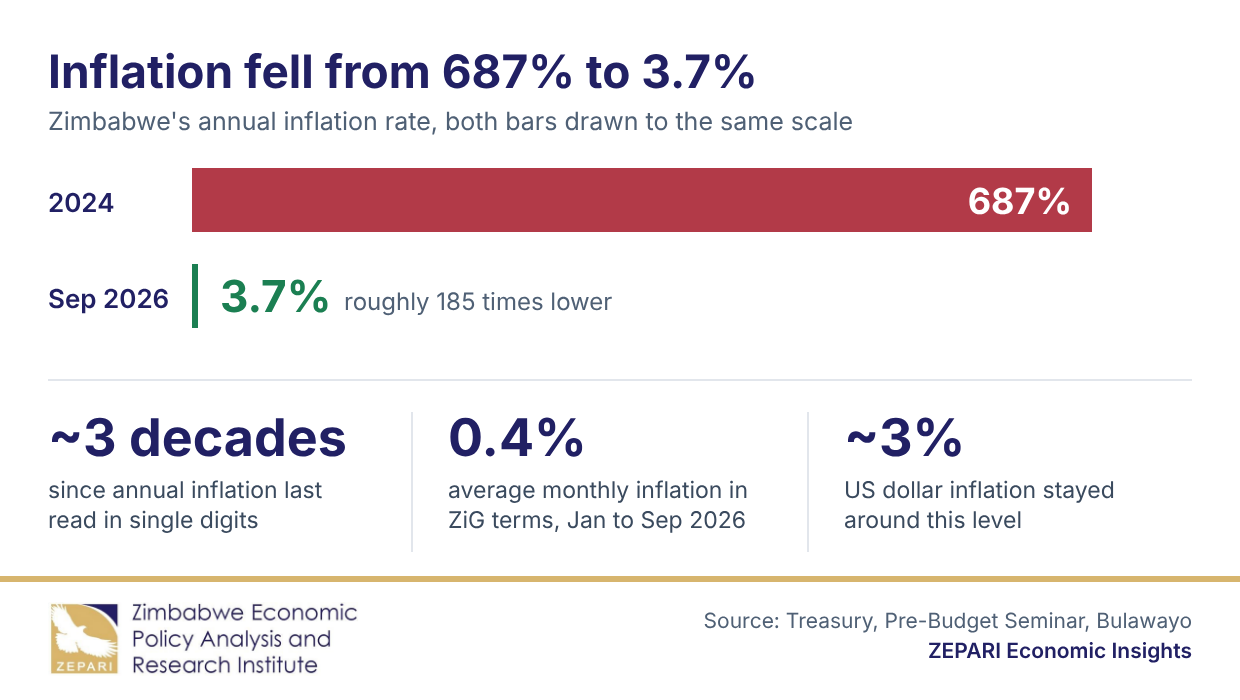
- Prices: Annual inflation fell from 687% in 2024 to 3.7% in September 2026, the first single-digit reading in about three decades.
- Production: Agriculture, manufacturing, mining and tourism are all reporting gains.
- External position: Exports, remittances and reserves have all risen, and the current account is in surplus.
- Risks: Treasury projects growth to slow to 3.5% in 2027, with a strong El Niño and a weaker global outlook as the main threats.
Why these matters
Zimbabwe's economy has changed significantly since 2017. Output has expanded, inflation has eased, production has recovered in key sectors, and the external position has strengthened.
These developments were at the center of this year's Pre-Budget Seminar in Bulawayo, where Finance Minister Professor Mthuli Ncube presented Treasury's ten-year view of the economy and the opportunities and risks shaping the 2027 National Budget.
The progress is real. It also raises a harder policy question: how can Zimbabwe sustain these gains and make sure growth reaches households, businesses and workers?
Six Indicators that tells the story
| Indicator | Latest reported figure | Earlier reference point |
| Real GDP growth | 8.3% (2025) | SADC cumulative growth of about 10% vs Zimbabwe's about 16% since 2018 |
| Annual inflation | 3.7% (September 2026) | 687% (2024) |
| Manufacturing capacity utilization | 61.2% (2025) | 45.1% (2017) |
| Exports | US$11 billion (2025) | US$5.3 billion (2020) |
| Gold and foreign currency reserves | US$1.5 billion (June 2026) | US$697 million (June 2025) |
| Diaspora remittances | Over US$1.55 billion (first half of 2026) | Up 41.4% on the same period of 2025 |
| Projected growth | 3.5% (2027) | 8.3% (2025) |
Source: Treasury figures presented at the Pre-Budget Seminar.
1. A larger economy, but growth must deliver more
Treasury reports that the economy is now more than twice the size it was in 2017. Nominal GDP is projected to reach US$66.4 billion in 2026 and US$69.1 billion in 2027.
Real growth of 8.3% in 2025 was among the strongest in Africa. Ethiopia was the only country reported to have grown faster, while South Africa recorded 1.1% and Nigeria 4%. Since stabilization measures began in 2018, Zimbabwe's cumulative growth of about 16% compares with about 10% for the Southern African Development Community (SADC).
What it means: A bigger economy does not automatically mean higher household incomes, better-quality jobs or fairer access to opportunity. The next phase of policy needs to focus on the quality and inclusiveness of growth, not only its size.
2. Price stability: a major gain that must be protected
For most people, economic stability is felt in the cost of living and the ability to plan ahead. Annual inflation fell from 687% in 2024 to 3.7% in September 2026. Monthly inflation in ZiG terms averaged 0.4% between January and September, while US dollar inflation stayed around 3%.
What it means: Predictable prices help households plan their spending, help businesses set prices and give investors more confidence in longer-term projects. Keeping this stability will depend on fiscal discipline, credible monetary policy, a stable exchange rate and growing confidence in the domestic currency.
3. Productive sectors are driving the recovery
Agriculture. Output grew by 27.9% in 2025, supported by favorable conditions, climate-smart farming under Pfumvudza/Intwasa and Government input programmes. Tobacco reached a record 355 million kilograms in 2025 and 359 million in 2026, with contract farming accounting for 91.1% of deliveries. Milk production has nearly doubled since 2017 to 131 million liters, egg production has risen from 37.8 million to 125 million dozen, and the national cattle herd has recovered to 5.9 million.
Manufacturing. Capacity utilization rose from 45.1% in 2017 to 61.2% in 2025, and Treasury projects it will exceed 63.5% in 2026. Output is reported to be 41.4% above its 2022 level, with quantified investment of US$3.56 billion.
Mining. Gold production has doubled since 2017 to more than 55.5 tones. Lithium, negligible in 2019, reached a reported 2.6 million tones in 2026. Lithium exports of US$2.15 billion account for 45.6% of mineral exports excluding gold, ahead of platinum group metals.
Tourism. More than 792,000 visitors arrived in the first half of 2026 and receipts rose 6% to US$537 million. Under the Open Skies Policy, the number of airlines serving Zimbabwe has grown from three in 2020 to 20.
What it means: The next gains will come from irrigation, affordable finance, livestock disease control, stronger local supply chains and, above all, value addition: processing more of what Zimbabwe grows and mines before it is exported.
4. Infrastructure and water security
Treasury highlighted progress on the Harare-Mazowe Road, the Harare-Beitbridge route and the Bulawayo-Victoria Falls highway. On water, Gwayi-Shangani Dam is reported to be 76% complete and Kunzvi Dam 72% complete, and 5,395 boreholes have been drilled nationwide.
What it means: Reliable water supports farming, industry, cities and household welfare. The 2027 Budget will need to prioritize timely completion of strategic projects, transparent monitoring and a clear link between infrastructure spending and productive activity.
5. Stronger external balances
Exports rose from US$5.3 billion in 2020 to US$11 billion in 2025. In the first eight months of 2026 they increased by a reported 60.7% to US$9 billion, and Treasury projects US$14.9 billion by year-end.
Diaspora remittances exceeded US$1.55 billion in the first half of 2026, up 41.4% on the same period in 2025, and are projected to pass US$3.2 billion for the year. The current account recorded a surplus of US$1.1 billion in the first half of 2026, against US$248.2 million a year earlier. Gold and foreign currency reserves rose from US$697 million in June 2025 to US$1.5 billion in June 2026, and Treasury expects US$2.2 billion by the end of 2026.
What it means: A stronger external position gives Zimbabwe more room to absorb shocks. Keeping it will require export diversification, investment and continued foreign currency generation.
6. Risks to the 2027 outlook
- Slower growth: Treasury projects growth to moderate to 3.5% in 2027, reflecting a possible strong El Niño and a less favorable global environment.
- Agriculture exposed: Tobacco output is projected to fall to 310 million kilograms.
- Oil prices: Prices rose to about US$120 a barrel in April amid Middle East tensions, and Government removed diesel taxes to cushion fuel prices.
- Commodity dependence: Gold prices above US$5,500-ounce support export earnings but also show how exposed the economy is to international price swings.
Four priorities for 2027
- Protect macroeconomic stability. Low, predictable inflation is a foundation that needs consistent fiscal and monetary discipline, not an achievement secured once and for all.
- Strengthen climate resilience and food security. El Niño risks make irrigation, water infrastructure, drought-tolerant crops and climate-smart agriculture more urgent, to protect rural livelihoods.
- Accelerate domestic value addition. Processing more tobacco, lithium, gold, dairy and other commodities locally can deepen industrial links, create jobs, expand exports and keep more value in the country.
- Improve spending efficiency and accountability. The impact of the Budget depends not only on how much Government allocates, but on how effectively resources are used. Delivery against the Government's ten budget priority areas should be assessed through measurable outcomes, rather than expenditure announcements alone.
The bottom line
Since 2017, Zimbabwe has recorded important gains in output, price stability, production, infrastructure and external balances. These provide a stronger platform, but sustaining the recovery will take more than favorable headline figures.
The 2027 National Budget should consolidate macroeconomic stability while accelerating productive investment, strengthening climate resilience, supporting industrialization and improving the efficiency of public spending.
Economic progress will ultimately be measured not by the size of the economy, but by its ability to create jobs, raise incomes, expand opportunities and improve the welfare of Zimbabweans.
ZEPARI is committed to promoting evidence-based economic policy research for better policymaking and Zimbabwe's sustainable economic transformation.