




The US$45.4 Billion Imperative: Unlocking Infrastructure to Drive Industrial Competitiveness
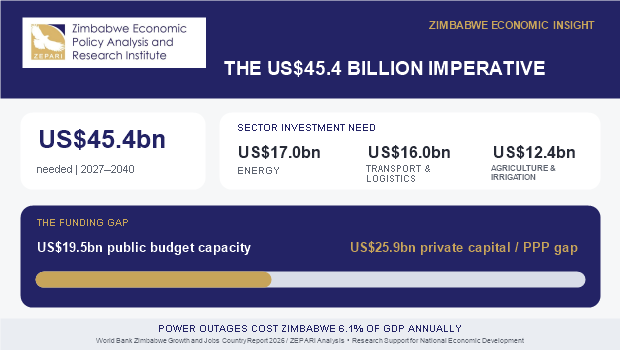
Physical infrastructure constrains represent one of several bottlenecks to regional competitiveness for Zimbabwean business looking to scale. A policy analysis by the Zimbabwe Economic Policy Analysis and Research Institute (ZEPARI) based on the World Bank's Zimbabwe Growth and Jobs Country Report 2026 highlights these physical limitations as the primary hurdle facing local producers. While recent macroeconomic stabilization has brought welcomed exchanged rate stability and reduced inflation, the underlying structural engine of the economy remains constrained by severe infrastructure deficits. The World Bank's assessment identifies power outages alone as costing the Zimbabwean economy 6.1% of GDP every year, starving manufacturing and mining operations of continuous, cost-effective production.
To overcome these constraints and place the country on a path toward sustained industrialization, the report outlines an estimated US$45.4 billion infrastructure investment requirement between 2027 and 2040.
Breaking Down the US$45.4 Billion Capital Need
The World Bank's research breaks down this US$45.4 billion requirement across three critical economic pillars.
- Energy (US$17.0 Billion): Prioritizing grid expansion, competitive electricity procurement, standardized Power Purchase Agreements (PPAs), and cost-reflective tariffs to attract private capital.
- Transport Corridors (US$16.0 Billion): Rehabilitating primary trade arteries, including the Harare-Beitbridge, Harare-Chirundu, and Harare-Mutare corridors while ring fencing maintenance funds and restructuring the National Railways of Zimbabwe (NRZ).
- Agriculture and Irrigation (US$12.4 Billion): Expanding farmer led irrigation beyond the current 5% arable land, upgrading cold chain logistics, and building digital market platforms.
Crowding in Private Capital
With World Bank models expecting public financial capacity to reach approximately US$19.5 billion, the Zimbabwean government cannot bridge this multi-billion-dollar gap using national budget alone.
ZEPARI's analysis emphasizes that closing the gap requires shifting from public led, debt financed spending toward derisked Public Private Partnerships (PPPs
| Strategic Focus Area | Key Policy & Reform Mechanism |
| Regulatory Stability | Establishing transparent, predictable power tariffs and clear foreign exchange repatriation mechanism. |
| Project Derisking | Utilizing credit guarantees and blended finance instruments from international financial institutions. |
| Targeted Capital Allocation | Rigorously appraising projects based on economic rate of return, export generation potential, and job creation. |
Industrialization and Regional Integration under AfCFTA
Fixing energy, transport, and irrigation is not simply a capital expenditure exercise, it is the prerequisite for enabling Zimbabwean manufacturers, farmers, and miners to compete effectively under the African Continental Free Trade Area (AfCFTA).
Currently, high transport costs and electricity surcharges make local manufactured goods more expensive than regional imports. By lowering input costs through reliable domestic infrastructure, Zimbabwe can transition from exporting raw, unprocessed minerals and agricultural commodities toward domestic mineral processing, and light industrial manufacturing.
As Zimbabwe prepares its National Development Strategy 2 (NDS2), infrastructure development must be viewed not merely as public works, but as the foundation of national competitiveness.
By Decent Moyo