




ZIMSEC Exam Fee Support: What Changes in 2027 and 2028?
ZEPARI Economic Insights | Policy Explainer
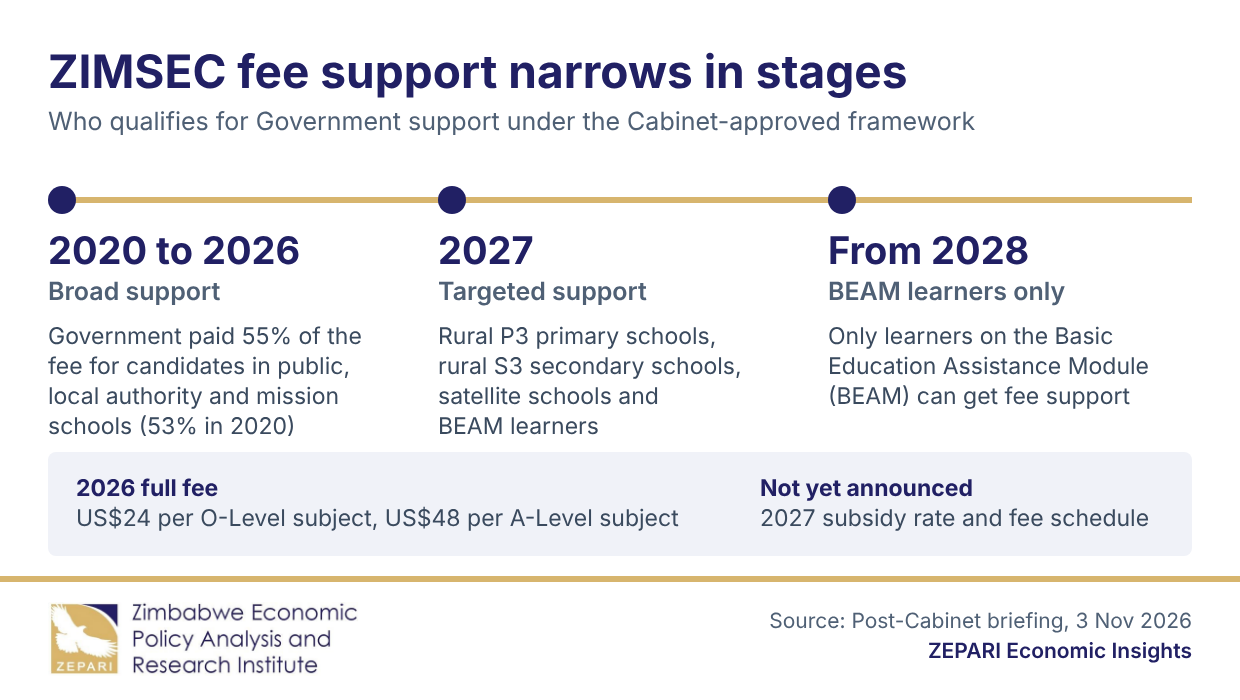
Cabinet has approved a new financing model for ZIMSEC examination fees. Government support will narrow in stages: to specific groups of learners in 2027, and to learners on the Basic Education Assistance Module (BEAM) alone from 2028. This explainer sets out what has been announced, what has not, and what to watch.
In brief
- What was approved: Cabinet approved a revised ZIMSEC Examination Fee Subsidy Framework and Examination Financing Model, announced at the post-Cabinet briefing on 3 November 2026.
- 2027: Government support continues for pupils in rural primary schools classified as P3, rural secondary schools classified as S3, satellite schools, and learners on BEAM.
- From 2028: BEAM beneficiaries become the only learners eligible for fee support.
- Not yet stated: The announcement did not give a new subsidy percentage or a 2027 fee schedule.
- Government's aim: To concentrate limited funds on the most vulnerable learners while protecting the running and security of national examinations.
How the support has worked until now
The subsidy was introduced in 2020 as a COVID-19 relief measure. At the start, Government covered 53% of examination fees and families paid the remaining 47%. From 2021, Government's share rose to 55%.
In 2026, the full examination fee and the amount paid by public-school candidates were as follows:
|
Level |
Full fee per subject |
Paid by public-school candidates |
|
Ordinary Level |
US$24 |
US$11 |
|
Advanced Level |
US$48 |
US$22 |
Source: ZIMSEC Finance Circular No. 5 of 2026 (27 February 2026)
Government support covered up to 7 subjects at O-Level and 4 subjects at A-Level, including Communication Skills. Candidates entering more subjects paid the full fee for the extra ones. Candidates in private schools and colleges, and private candidates in public schools, paid the full fee. The Ministry's limit on subjects entered is nine at O-Level and three at A-Level, with a maximum of four.
What is changing
|
Period |
Who receives Government support |
|
2020 to 2026 |
Candidates in public, local authority and mission schools (53% of the fee in 2020, 55% from 2021) |
|
2027 |
Rural P3 primary schools, rural S3 secondary schools, satellite schools, and BEAM learners |
|
From 2028 |
BEAM beneficiaries only |
BEAM is the Government programme that pays school fees, levies and examination charges for learners who cannot afford them.
What it could mean for a family
Using 2026 fees as an illustration: a pupil writing seven O-Level subjects, the most the subsidy covered, paid about US$77 (7 x US$11). The full fee for the same subjects is US$168 (7 x US$24). A pupil writing nine subjects, the Ministry's maximum, paid about US$125, because the two extra subjects were charged at the full US$24, against US$216 at the full fee. At A-Level, three subjects cost US$66 with the subsidy (3 x US$22), against US$144 at the full fee (3 x US$48).
These figures show the size of the gap at 2026 rates. Fees and support levels for 2027 and 2028 have not yet been announced.
Why Government says it is changing the model
Officials say the existing model did not sufficiently separate households that need help from those able to pay. They also cite fiscal constraints and competing national priorities. Finance Minister Professor Mthuli Ncube has described the subsidy as a pandemic-era relief measure that is now being streamlined.
This fits the wider picture in the 2027 Budget process, where Treasury has said spending requests far exceed available revenue.
The delivery question: BEAM
Targeting works only if the targeted channel works, and from 2028 BEAM will be the sole route to fee support.
Parliament was told that BEAM arrears accumulated to about US$292 million between 2023 and 2025, which the Government attributes to limited fiscal space. Figures presented to Parliament show 1,856,996 beneficiaries in 2023, 1,261,140 in 2024 and 950,192 in 2025.
Treasury has since put the current stock of outstanding obligations for 2023 to 2025 at US$98 million, so the two figures differ. The Government says an independent audit of beneficiaries will establish an accurate, non-contested figure. That audit is expected within the 2026 financial year, with clearance of verified arrears planned for 2027 to 2030, subject to available fiscal space. Until then, Treasury has said payments will continue at a slow pace, with special schools prioritized.
Treasury has also said that preliminary information suggests a significant portion of the current BEAM list may not comprise deserving cases, and that many genuinely needy pupils are being excluded. Legislators have raised concerns that schools carry the cost of educating BEAM learners while waiting to be paid. At the pre-budget seminar, Minister Ncube said about US$100 million had been released two weeks earlier to clear some arrears.
Questions that remain
- What share of the fee will Government cover for eligible candidates in 2027, and what will the fee schedule be?
- How will BEAM beneficiaries be identified, and how will vulnerability be verified?
- How and when will BEAM arrears be cleared, so that schools and examination centres are paid on time?
- What will registration and payment arrangements look like for families who no longer qualify?
- Will the 2027 National Budget, to be presented on 19 November, set out funding for BEAM and examination support?
Wider context
The Ministry of Primary and Secondary Education's 2025 statistics report (EMIS) recorded 39,736 learners leaving school in 2025, with financial constraints the leading reason. These figures cover school dropout overall rather than examination fees specifically, but they point to the pressure many households face.
The bottom line
The new framework is an attempt to direct limited public resources to the learners who need them most. Whether it achieves that will depend on three things: accurate identification of eligible learners, timely payment of BEAM obligations, and clear communication to families before registration opens.
By Decent Moyo
ZEPARI is committed to promoting evidence-based economic policy research for better policymaking and Zimbabwe's sustainable economic transformation.